

Portable ladders are our great allies when it comes to making minor repairs at home. Whether it is repairing ceiling cracks, fixing the hanging door of the highest kitchen cupboards or changing the living room lamp, we always turn to them to successfully complete our home DIY tasks. However, when using domestic ladders it is very important to follow all safety measures, as even though these may be sporadic tasks at home, a bad practice or improper and reckless use of the ladder can cause falls from height that can sometimes have irreparable consequences.
Sometimes, our hectic lifestyle means that not only do we leave home repairs to the last minute, but when we do get down to work, we are not 100% focused and forget the dangers that domestic ladders involve. Carelessness during DIY tasks or not knowing how to position the ladder correctly are just some of the actions that can cause unnecessary accidents. Although exceeding the permitted weight, using the wrong type of ladder for a specific task or wearing inappropriate footwear are very common mistakes made by users, at Altipesa we have compiled the three most common errors when using domestic ladders that should therefore be avoided.
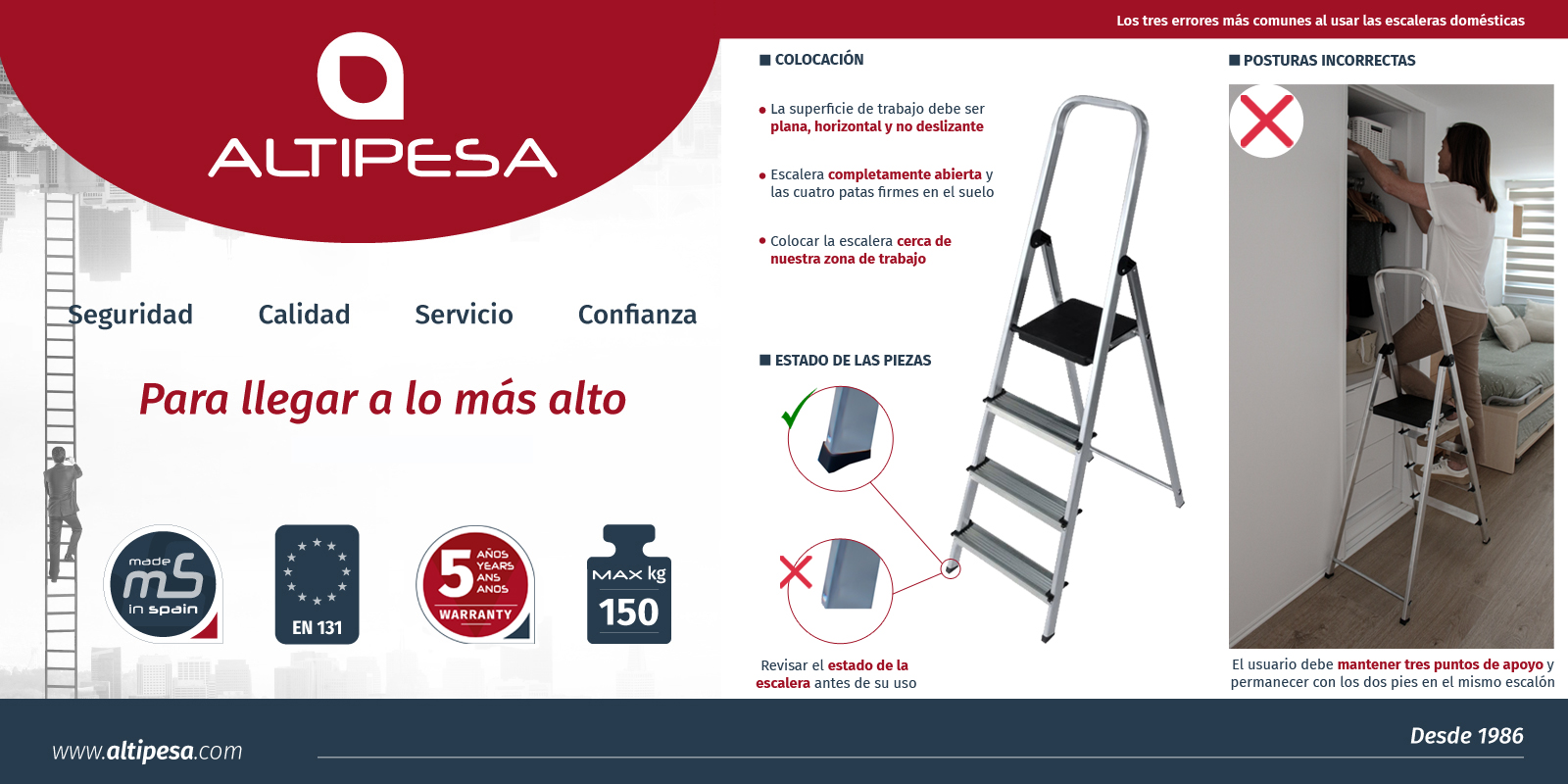
1 – Incorrect postures. Although very little attention is paid to how we are positioned on domestic ladders while carrying out DIY tasks, the body position we adopt is key to maintaining balance and avoiding falls from height. For this reason, both during ascent and descent and while remaining on the ladder, it is very important to maintain three points of contact, meaning that both feet and one hand must rest on the ladder. On the other hand, whether fixing the drawers of the highest shelves in the home or hanging pictures, it is important for the user to keep both feet on the same step to guarantee maximum safety.
Sometimes, while carrying out our tasks, we tend to reach out when we cannot reach the object or area we need to work on — a very dangerous action that not only prevents us from working in an ergonomic position but also puts our safety at risk. For this reason, it is essential to always remain between the stiles of the ladder to ensure our stability. If we need to reach any other more distant point, it is recommended to descend the ladder facing forward, move it to the desired location and then climb back up to continue working from a closer distance without putting our safety at risk.
2 – Absence or defect of ladder components. Aluminium ladders, the most widely used in the domestic setting, tend to have a very long service life, provided we carry out proper maintenance. However, sometimes some of their parts can deteriorate due to the passage of time or improper use, which obliges us to replace them — if possible — or to permanently retire the ladder.
Altipesa’s domestic ladders incorporate feet or end caps with anti-slip ridges, an essential element that prevents the ladder from accidentally sliding on the surface while household tasks are being carried out. If we detect that our ladder lacks this component or that it is in poor condition, it is important to take the ladder out of use and immediately request a replacement, as otherwise our safety will be compromised. On the other hand, our domestic ladders also have polypropylene (PP) platforms with an exclusive locking system, a mechanism that prevents the ladder from folding while we are using it. For this reason, before use, it must be checked that it is in good condition to prevent possible falls from height.
For your safety, remember to check the condition of the ladder to guarantee safe and stable work at height. Make sure all its parts are correctly assembled and that the steps and stiles are in good condition.
3 – Improper positioning. Even though we are carrying out home DIY tasks, it is important for the user to follow all safety measures to avoid accidents. Before starting our tasks, it is advisable to check that the space where we are going to place the ladder is free of obstacles and is a flat, horizontal and non-slip surface. Therefore, the ladder must not be leant against unstable objects that could affect our stability, and doors and windows should be kept open so we are visible and to prevent openings that could destabilise us.
The stepladder is the most common model in homes, so when using it, we must make sure it is completely open and all four legs are resting on a firm surface, as otherwise it could accidentally fold, putting our safety at risk. It is also advisable to place the ladder very close to our work area to adopt an ergonomic position, achieving a right angle relative to that point.
All the products available in the Altipesa catalogue comply with the respective European safety standards and have been manufactured with rigorous quality controls at every stage of the process. Our company is a national leader in the production and manufacture of ladders and stools, offering our customers and users safety, quality and confidence to reach the highest.
