

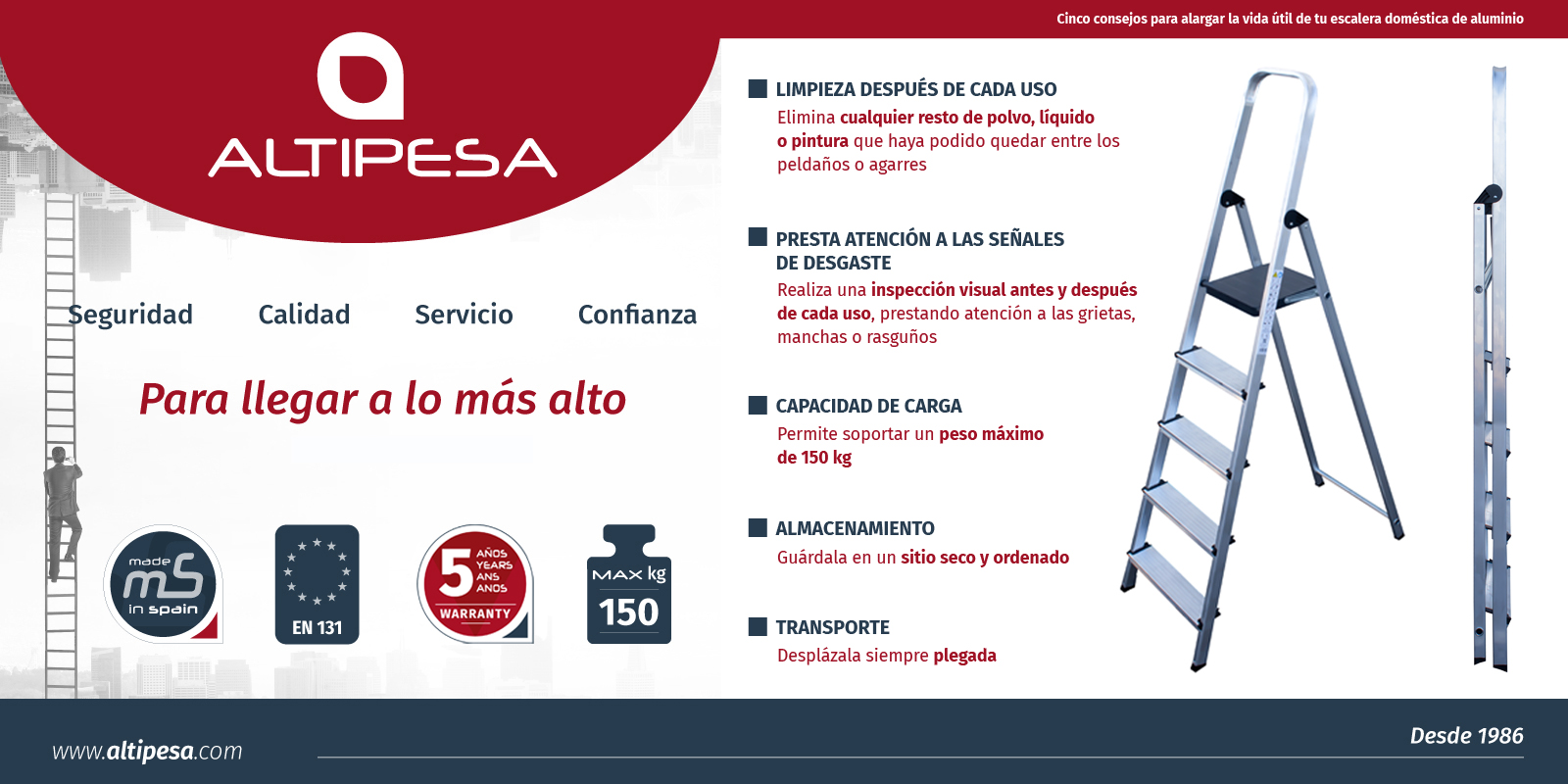
The domestic aluminium ladder is an indispensable tool for carrying out DIY or cleaning tasks inside and outside the home. For this reason, when carrying out household tasks, it is important to choose the ladder that best suits your needs, taking into account the height you want to reach or the use you will give it, among other factors. Only then will your safety be guaranteed during work at height.
Most people opt for aluminium ladders due to their many advantages. This model is characterised by being lightweight, sturdy, easy to handle and easy to maintain. However, to ensure it works properly, it is necessary to care for it and keep it in optimum condition. With the aim of extending the service life of your domestic aluminium ladder, at Altipesa we offer five tips so you can use it for much longer.
1. Clean it after each use. Once home DIY tasks are finished, it is important to clean the ladder to keep it in good condition and extend its durability. It is therefore necessary to remove any dust, liquid or paint residue that may have remained on the stiles, steps or handles, as certain substances can make them slippery or deteriorate the anti-slip coating on the feet, which could cause accidental falls. In addition, the hinge system must be free of dirt to guarantee its proper functioning and user safety.
To clean your ladder, you should use products that will not damage or spoil it. It is recommended to use water and mild soap to remove dirt residue while, if necessary, opting for water and vinegar solutions to remove more stubborn stains.
2. Pay attention to signs of wear. It is important to replace damaged elements as quickly as possible, as otherwise deteriorated parts could affect others that are more difficult to replace. For this reason, a visual inspection should be carried out before and after each use to determine whether the ladder is safe, paying attention to signs of wear, stains, cracks or scratches.
It is also necessary to check that the anti-slip end caps are not worn, verify that the steps are level and firm, check that the platform locks and sits correctly, and observe that the ladder is not suffering from corrosion due to humidity.
3. Do not exceed its load capacity. This capacity refers to the weight the ladder can support without being damaged or putting your safety and health at risk. Altipesa’s domestic ladder models comply with European Standard EN 131, so the user must not exceed a maximum weight of 150 kg, including their own weight and the tools or materials to be used.
4. Store it correctly. The ladder should be stored in a dry and tidy place. It is therefore advisable not to store it outdoors to avoid dirt or adverse weather conditions, which can affect the proper functioning of the hinges, locks or safety mechanisms, among other elements. In addition, to prevent them from tipping over and being damaged, ladders should never be stored in a leaning position, so the ideal option would be to fix them to the wall using supports.
5. Transport it properly. When you need to move your domestic ladder from one place to another, it is important to do so with the front end facing down and never horizontally, as the risk of hitting objects or people is greater. Ladders should be moved folded and with the locking systems activated to prevent them from opening involuntarily.
With proper maintenance and use, you can extend the service life of your domestic aluminium ladder. By following these tips, you will not only keep your ladder for more years, but your safety during household and DIY tasks will be guaranteed. For this reason, if during a visual inspection you detect any element in poor condition — loose steps or worn anti-slip end caps — it is important not to use it until it has been repaired or replaced.
