

Domestic ladders are part of our daily lives as, thanks to them, we can carry out tasks such as hanging curtains, repairing lamps, cleaning windows, painting walls or reaching items in the highest areas of our home quickly and conveniently. However, although we make non-professional use of domestic ladders, we must follow a series of recommendations to guarantee our safety on them, as otherwise we would be putting our health at risk. At Altipesa we offer five tips that you should bear in mind before climbing your ladder. This way, you can carry out household tasks involving height with maximum guarantees, free from accidental falls, entrapment or trapping.
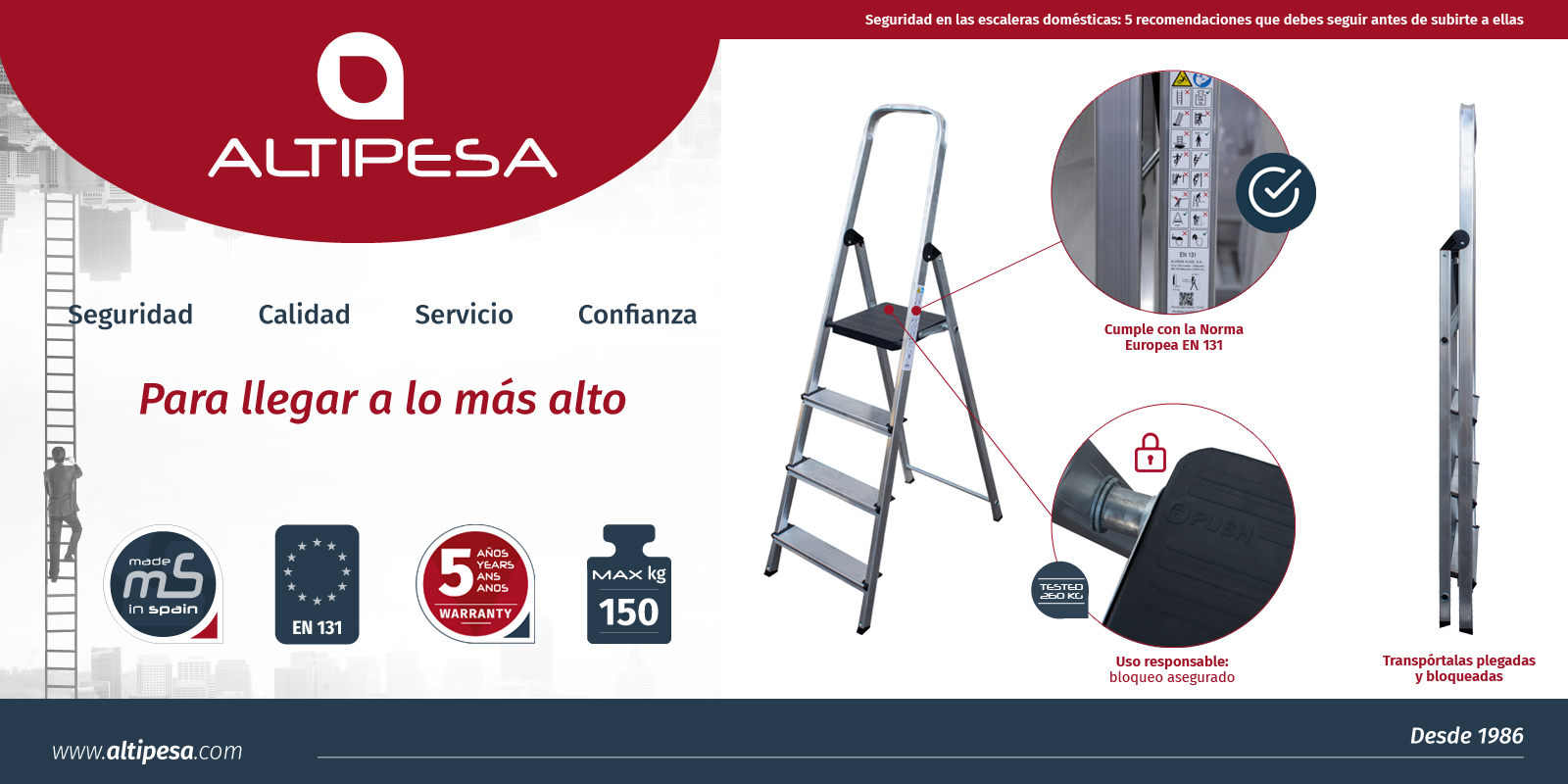
1 – They must comply with European Standard EN 131: Before using or even purchasing our domestic ladder, it is important to verify that it complies with European Standard EN 131. This standard, which applies to both professional and non-professional ladders, sets out the quality and safety requirements that portable ladders must meet in order to guarantee user safety and confidence. At this point, attention must be paid to its load capacity, as according to Standard EN 131, the domestic ladder must not exceed a maximum weight of 150 kg, including the tools we need. In addition, the ladder should only be used by one person at a time. Also, the step tread must not be less than 20 mm, so if it does not reach that measurement, we will be obliged to reject its use. All the ladders we make available to our customers and users in the Altipesa catalogue are manufactured in accordance with European Standards EN 131.
2 – Work area: Before positioning the ladder to carry out our home DIY tasks, it is advisable to study the work area. If we are going to use a stepladder for our work at height, it is important to verify that the space where we are going to place it allows it to be fully open, as otherwise it would not meet our needs, and we should opt for another ladder model. Altipesa’s platform stepladders incorporate a polypropylene (PP) platform with an exclusive locking system, so if the work area does not allow the ladder to be placed completely open with this lock secured, its use must be ruled out. On the other hand, we must work on a stable, flat surface free of objects to achieve maximum stability and avoid accidental falls.
3 – Responsible use of the ladder: An important part of guaranteeing maximum safety on domestic ladders falls on the common sense of users. For this reason, it is up to them to adopt the safety measures that will allow them to carry out their home DIY tasks stably and with maximum confidence. When purchasing your ladder, it will be advisable to read the instruction manual to understand how it works and the parts that make it up, in order to check its condition at each use. Among the recommendations that ensure correct use of the ladder are the correct positioning of the ladder on a flat surface, always ascending facing forward and with hands free of objects to avoid hindering the ascent, among other aspects.
4 – Comfort and ergonomics: To work safely on your domestic ladder, it is advisable to do so with maximum comfort and ergonomics. For this reason, it is important to know how to choose the ladder that best suits your needs, which is why attention must be paid to elements such as the number of steps or the working height. If you are going to carry out repairs involving small heights over extended periods of time, it will be advisable to opt for platform ladders, while in the case of outdoor tasks or in areas with very high ceilings, you should choose multi-function ladder models, which will allow you to reach heights of several metres.
5 – Correct transport: How many times have we gone to put away a ladder and, when transporting it, knocked it against walls or door frames? Although we consider these to be minor knocks, these actions can seriously damage the ladder and put our safety at risk. For this reason, just as with professional ladders, domestic ladders also have their technique for correct transport: always with the front end facing down and never in a horizontal position, as this increases the chance of hitting objects or people. They must also be transported folded and properly locked to prevent them from accidentally opening.
At Altipesa we offer our customers and users a wide variety of domestic ladder models with the necessary safety, quality and confidence to reach the highest. All our products are continuously being developed and come with a five-year guarantee against manufacturing defects.
