

Ladders are tools that allow us to carry out tasks at height comfortably, stably and safely. For this reason, when we want to hang a picture, clean the windows, paint the ceiling or, in short, reach the highest areas of our home, we rely on the ladder as our work companion. However, before getting started with our home DIY tasks, it is important to inspect that all the parts of our domestic ladder are in perfect condition and will not let us down while we carry out our tasks.
At this point, an important question must be asked: do we know what parts make up our domestic ladder? Generally speaking, the most common model in homes is the stepladder, as it offers the user great reliability, comfort and safety when carrying out DIY tasks.
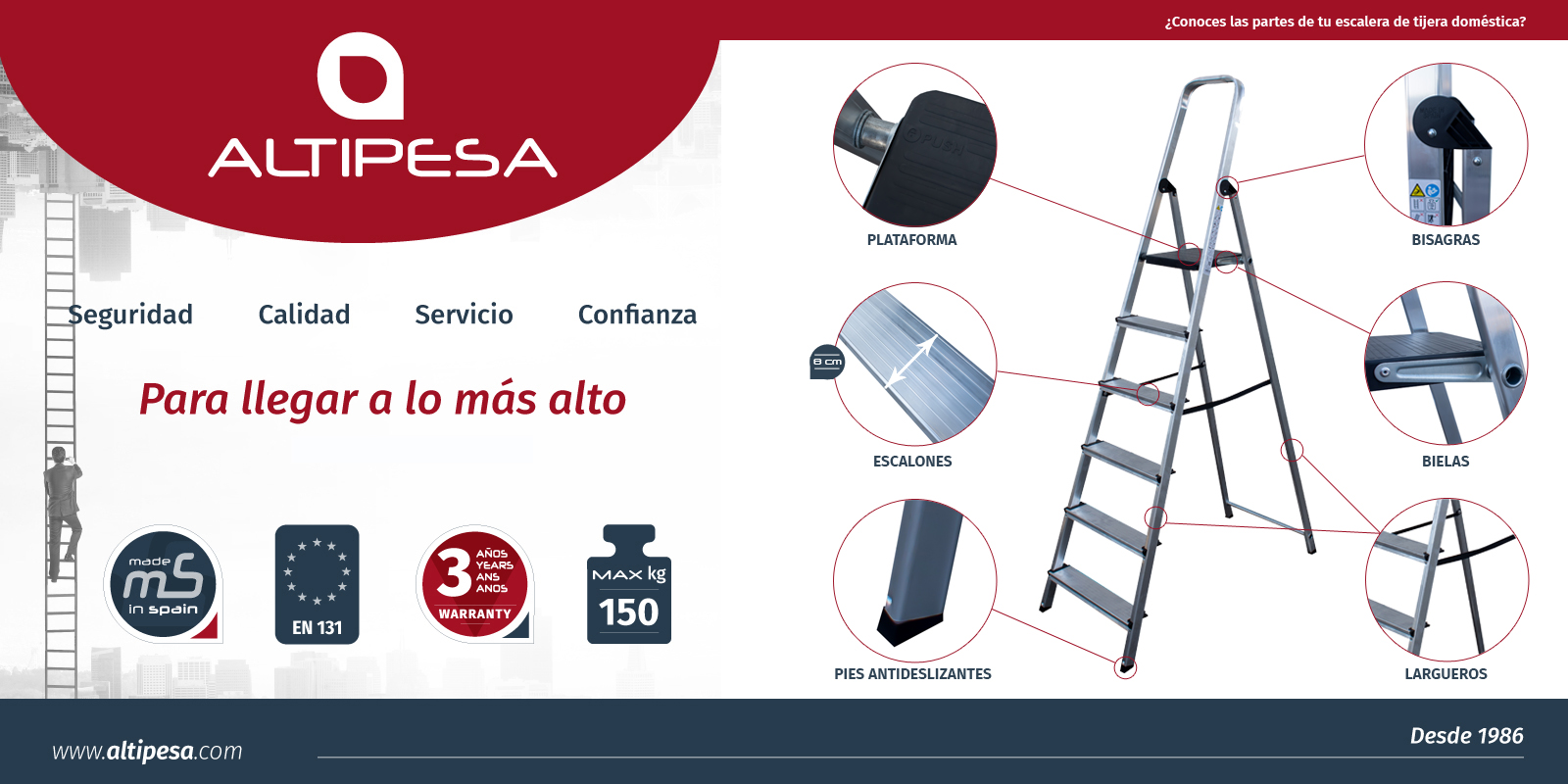
The domestic stepladder is made up of different parts, each of which has a specific function: platform, steps, hinges, connecting rods, stiles and anti-slip feet.
– Platform: This element, which serves as the upper support surface, guarantees the user’s safety on the ladder. The models we offer at Altipesa are manufactured with a reinforced polypropylene (PP) platform with anti-slip ridges. This way, in addition to reducing the risk of falls, the user can be sure that the platform can support loads without suffering permanent deformation, unlike metal ones. Altipesa domestic stepladders also incorporate an exclusive safety locking system, so that, with a small amount of pressure, the platform is firmly secured, preventing accidental opening and guaranteeing user safety. The 25×25 cm platform with anti-slip ridges allows comfortable and safe work.
– Steps: These allow the user to ascend and descend the ladder comfortably to reach the highest areas of the home. At Altipesa we offer stepladders that comply with the safety requirements established in European Standard EN 131. Regarding this standard, there are two aspects to bear in mind: the tread depth — which must be at least 8 cm, although some models such as the wide-step stepladder can reach 12 cm — and the distance between steps — which must be a minimum of 23 cm and a maximum of 30 cm. At Altipesa we continuously work to offer maximum stability and safety to our customers and users, which is why all our domestic stepladder models feature steps with anti-slip ridges.
– Hinges: Devices that connect and secure the ascent and support sections of the ladder durably. The hinges are designed so that during use there is no trapping or rubbing with other parts of the ladder. The ladder models we offer at Altipesa incorporate reinforced PP hinges.
– Connecting rods: A mechanism that allows the platform to be raised at the same time as the ladder is folded. The domestic stepladder models we offer at Altipesa have galvanised steel connecting rods, a material characterised by its strength and durability.
– Stiles: These are the lateral elements of the stepladder, which support the steps and the crossbars of the support sections. It is important that, when ascending or descending our domestic ladder, we always do so facing forward and holding firmly onto the ladder while going up and down.
– Anti-slip feet: These are the ends of the stiles that prevent the ladder from sliding while we are on it. Although we may sometimes overlook the importance of these elements, the anti-slip end caps play a key role in the proper functioning of the ladder, as they keep it completely stationary, guaranteeing the safety of users while they carry out their home DIY tasks. For this reason, it is important to make sure that our domestic ladder has its anti-slip feet properly fitted and in perfect condition, as otherwise the ladder could accidentally slide on the surface, causing falls with serious consequences.
